A parking lot or garage can feel like one of the safer places to ride. Speeds are lower, and you’re away from busy roads. But tight turns, steep ramps, poor lighting, and drivers backing out of spaces can turn a short ride into a serious crash in seconds.
If you were hurt riding an electric bike or electric scooter on someone else’s property, you may assume the property owner is to blame. Sometimes that’s true. Other times, a driver, a contractor, or another rider shares responsibility. Below, we explain how premises liability works in Florida, who may be accountable for your injuries, and how our premises liability lawyers can help you pursue the compensation you need.
How Florida Law Defines E-Bikes and E-Scooters
Florida treats e-bikes and e-scooters as separate devices, but the rules for riding them overlap in important ways.
E-Bikes in Florida: Classes, Speed Limits, and Rider Rights
Under Florida Statutes § 316.003, an e-bike has fully working pedals and an electric motor under 750 watts, which is roughly one horsepower, enough to assist your pedaling but far less than a moped or motorcycle.
E-bikes fall into three classes:
- Class 1 and Class 2 e-bikes stop providing motor assistance at 20 mph
- Class 3 e-bikes cap out at 28 mph
Under Florida law, e-bike riders have the same rights and duties as bicycle riders and can ride wherever bicycles are allowed.
E-Scooters in Florida: Definitions, Speed Limits, and Rider Rights
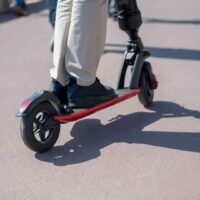
Florida law calls e-scooters “motorized scooters.” They travel on no more than three wheels and can’t go faster than 20 mph on level ground. The law gives e-scooter riders the same rights and duties as bicycle riders, too.
What E-Bike and E-Scooter Riders Share
Neither device requires a license, registration, or insurance. Riders under 16 must wear a helmet, and cities and counties can add their own rules.
Young riders face some of the greatest risks. In a recent AAA survey of Floridians, 66% of adults said they had seen children riding e-bikes or e-scooters without a helmet. To help young riders protect their futures, our firm created a free E-Bike & E-Scooter Safety Guide for Florida families.
Since neither device carries its own insurance, identifying who caused your crash is central to recovering compensation.
What Is Premises Liability?
Premises liability is the area of law that holds property owners responsible when unsafe conditions on their property injure someone. In Florida, owners and the companies that manage their property must keep it reasonably safe for the people who use it.
How much responsibility an owner has can depend on why you were on the property. You’ll also typically need to show that the owner knew about the hazard, or should have known about it, and failed to fix it or warn you. For example, a pothole left unrepaired for months may show the owner had plenty of time to address it.
Our personal injury lawyers know how to prove negligence, which means showing that someone’s carelessness caused your injuries.
Parking Lot and Garage Hazards That Cause E-Bike and E-Scooter Crashes
Parking lots and garages present hazards that drivers may barely notice but riders struggle to avoid, including:
- Potholes and cracked pavement
- Unmarked or faded speed bumps
- Dim or broken lighting
- Oil slicks and standing water
- Loose gravel and debris
- Broken or uncovered drain grates
- Steep ramps without warning signs
- Blind corners
- Damaged wheel stops
E-scooters have small wheels that can catch on a crack that a car tire would roll right over. E-bikes travel at higher speeds, giving riders less time to react. For both, a hazard that seems minor can cause a serious fall.
Is the Property Owner Always at Fault?
Not always. Parking lot and garage crashes often involve more than one responsible party, and our attorneys know how to determine liability, or who is legally responsible for your losses. Depending on your situation, that could include:
Property Owners and Managers
If a dangerous condition on property like a condo or high-rise caused your crash and the owner or property manager knew, or should have known, about it, they may be liable.
Drivers Entering, Exiting, and Parking Their Vehicles
A driver backing out of a space, cutting across lanes, or distracted by their phone may not see an e-bike or e-scooter until it’s too late.
Maintenance and Security Contractors
Owners often hire outside companies to repair pavement, maintain lighting, or patrol the property. If one of these companies failed to do its job, it may share responsibility.
Other Riders and Pedestrians
Sometimes another e-bike or e-scooter rider causes the crash, or a pedestrian steps into your path without warning.
Florida also follows a comparative negligence rule. Your compensation can be reduced by your share of the blame, and you can’t recover anything if you’re found more than 50% at fault. Insurers often use this rule to shift blame onto riders.
We are here for you 24/7
(Consultations are Free)
Who Pays After an E-Bike or E-Scooter Crash?
Compensation usually comes from other sources, such as:
- The property owner’s liability insurance, which often covers injuries caused by unsafe conditions
- The at-fault driver’s bodily injury coverage, if a car was involved
- Your household’s personal injury protection (PIP), which may apply when a motor vehicle is involved. PIP is no-fault coverage that pays part of your medical bills and lost wages, but you must get treatment within 14 days.
- Uninsured/underinsured motorist (UM/UIM) coverage, which can help if the driver has little or no insurance
- Your health insurance, which may cover treatment while your claim moves forward
Each policy has its own rules and limits, and we can review every available source with you.
Steps to Take After a Parking Lot or Garage Crash
What you do after your crash can affect your personal injury claim. If you can, take these steps:
- Get medical care right away.
- Photograph the hazard, your device, and your injuries before anything is repaired.
- Report the incident to property management and request a copy of the report.
- Collect names and phone numbers from witnesses.
- Ask about surveillance footage, since it’s often recorded over quickly.
- Keep your e-bike or e-scooter in its post-crash condition.
- Avoid giving recorded statements to insurance companies.
Florida generally gives you two years from the date of your crash to file a lawsuit under Florida Statutes § 95.11. Evidence can disappear long before then, so reaching out early protects your case.
How Our Lawyers Help Injured E-Bike and E-Scooter Riders
For us, this isn’t just our job; it’s our calling. We’re not a case mill that rushes clients toward the lowest acceptable settlement. We limit the number of cases we take so every client gets the attention they deserve. If you’re unsure whether your injuries are serious enough, call us anyway.
Our approach is built on our CARES values: Compassion, Accountability, Reliability, Excellence, and Success-Driven. We investigate your crash, gather evidence, negotiate with insurers, and go to court when needed. Our bilingual team can also help you in the language that works best for you.
Every case is different, and past results don’t guarantee future outcomes, but we can help you seek maximum compensation. However, we work on a contingency fee agreement, so you pay nothing up front, and your consultation is free.
Talk to a Florida E-Bike and E-Scooter Accident Lawyer Today
Since 1971, Meldon Law has spent more than 50 years helping injured Floridians and has recovered hundreds of millions of dollars for our clients. We also share legal knowledge through books, consumer guides, and our podcast, so you can make informed decisions.
If you were hurt in a parking lot accident or garage crash, Meldon Law won’t back down from your fight. Call us for a free consultation at one of our offices in Gainesville, Ocala, Lake City, Fort Lauderdale, Aventura, or Williston.