


 Nationally
In Florida
In 2022, the trauma center at Wolfson Children’s Hospital in Jacksonville treated three children for e-bike and e-scooter crash injuries. In 2025, it treated 115, and in the first six months of 2026 it treated 97, with the hospital projecting roughly 194 by the end of the year.
The pattern repeats across the state. Memorial Healthcare System in South Broward County recorded a 178 percent rise in trauma alerts between 2024 and 2025, and hospitals and police departments elsewhere in Florida are reporting the same trend.
Florida law has not moved with the numbers. The state still treats an electric bicycle as a bicycle, with no license, registration, insurance, or minimum riding age. In 2026, the Legislature passed a safety and data-collection package with no votes against it, and Governor Ron DeSantis vetoed it six days before it took effect.
Meldon Law has fought for injured Floridians since 1971, and we handle these crashes in Gainesville, Ocala, Lake City, and Fort Lauderdale. Families keep asking us how bad this really is, whether their child’s bike is legal, and who pays if a car hits them. This report answers all three.
The U.S. Consumer Product Safety Commission tracks these injuries through a nationally representative sample of hospital emergency departments. Its April 2026 report estimates 698,500 micromobility emergency visits between 2017 and 2024, climbing from 37,300 a year to 149,100. E-bikes account for 155,200 of them, and 59,200 fell in 2024 alone. Annual e-bike estimates for 2017 through 2021 were too small to report individually, so the agency uses an annualized average of 6,300.
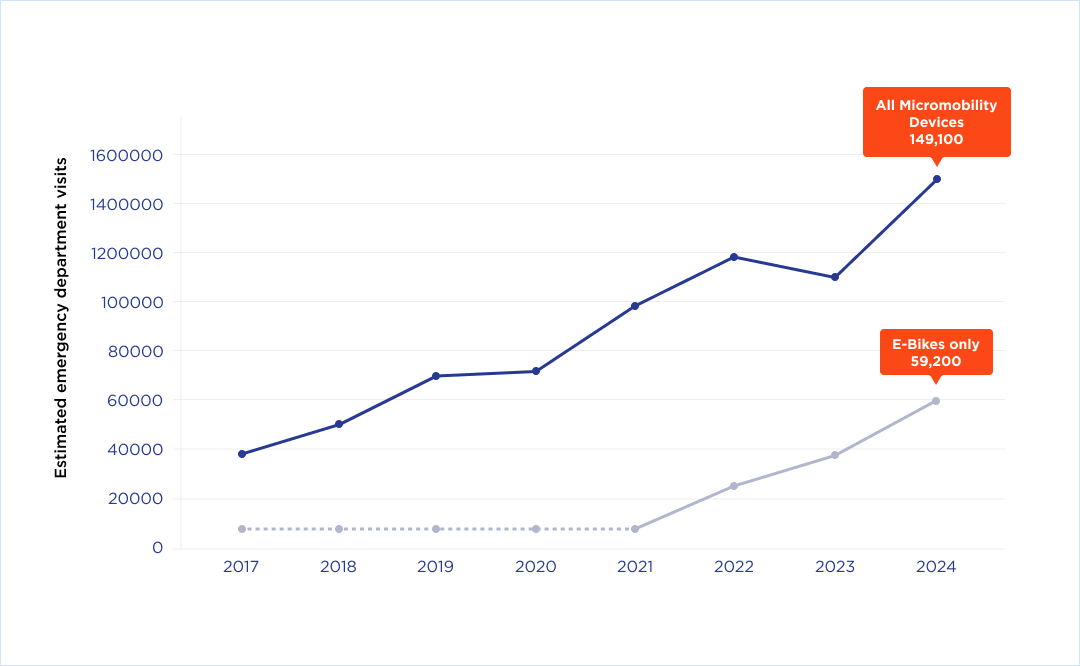
Source: U.S. Consumer Product Safety Commission, Micromobility Products-Related Deaths, Injuries, and Hazard Patterns: 2017-2024 (April 2026), NEISS estimates. E-bike figures for 2017-2021 are shown as the CPSC’s annualized average of 6,300 because the individual years did not meet NEISS reporting criteria.
| Year | All micromobility | E-scooters | Self-balancing scooters | E-bikes |
| 2017 | 37,300 | 10,600 | 22,900 | Not reportable |
| 2018 | 50,200 | 20,300 | 26,400 | Not reportable |
| 2019 | 66,900 | 39,100 | 22,200 | Not reportable |
| 2020 | 69,300 | Not reportable | 27,300 | Not reportable |
| 2021 | 97,500 | 61,200 | 23,300 | Not reportable |
| 2022 | 118,800 | 74,800 | 17,200 | 26,800 |
| 2023 | 109,400 | 58,400 | 13,400 | 37,600 |
| 2024 | 149,100 | 79,300 | 10,600 | 59,200 |
| Total | 698,500 | 380,000 | 163,300 | 155,200 |
Source: CPSC, Micromobility Products-Related Deaths, Injuries, and Hazard Patterns: 2017-2024 (April 2026). “Not reportable” means the estimate did not meet NEISS criteria. Pre-2024 data were reweighted after a sample revision.
Deaths follow the same curve. The CPSC counts 310 e-bike fatalities across those eight years, with the annual figure climbing from zero in 2017 to 97 in 2024.
Researchers at Columbia University’s Mailman School of Public Health separately found the rate of e-bike injuries rose 293 percent between 2019 and 2022, a period when U.S. e-bike sales rose 269 percent.
In CPSC data for 2017 through 2022, children 14 and younger accounted for about 36 percent of micromobility injuries while making up 18 percent of the population. In December 2025, Rady Children’s Health published the first study to isolate speed in pediatric e-bike trauma in the journal Injury, covering 437 patients who represent an estimated 15,121 children nationally.
Across 2019 through 2023, only 4.2 percent of those injuries happened in the first year and nearly 50 percent happened in 2023, meaning almost half of five years of injured children were hurt in a single year.
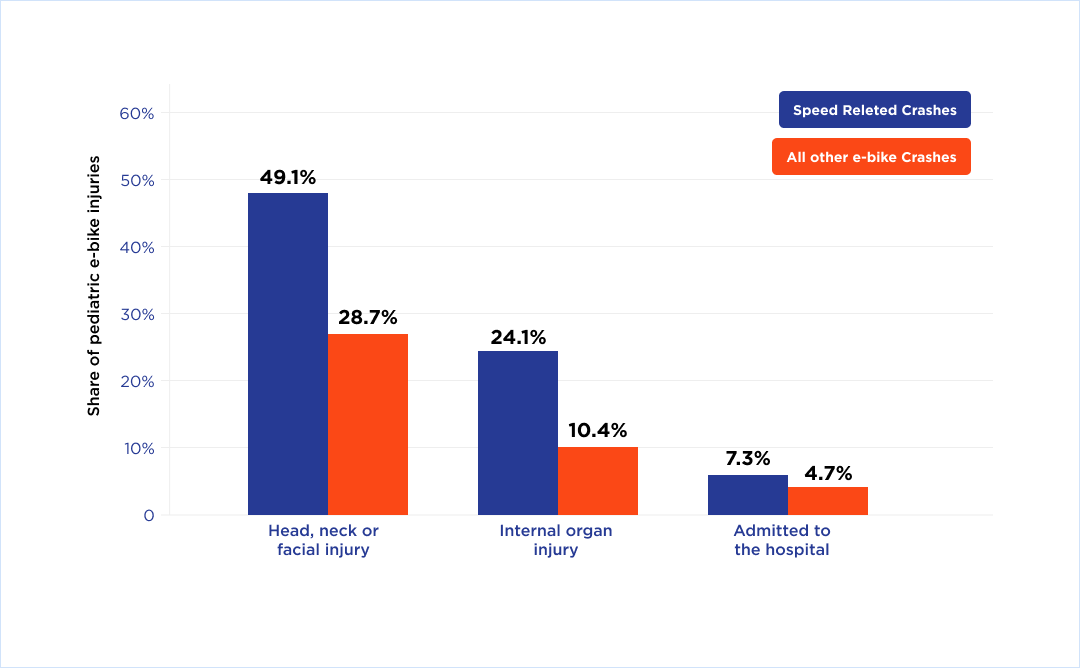
Source: Flyer ZE, Giron A, Schomberg J, et al. “Electric-bicycles and speed-related trauma in pediatrics: Risk of internal injury and hospitalization.” Injury, May 2026;57(5):112931 (published online December 4, 2025). Based on NEISS data for 2019-2023 covering an estimated 15,121 pediatric e-bike patients.
Among children whose injuries were classified as internal, 96.7 percent involved the head and neck. Study leader Dr. Laura Goodman described the problem in plain terms: children are riding vehicles that behave more like motorcycles than bicycles, most have never taken a safety class, and many do not know the rules of the road.
Speed changed the outcomes. When a crash was speed-related, 49.1 percent of the children suffered head, neck, or facial injuries, compared with 28.7 percent in other e-bike crashes, and 24.1 percent had internal organ injuries, compared with 10.4 percent.
| Circumstance of the crash | Share of estimated 2024 e-bike ED visits |
| Occurred on a paved road | 58 percent |
| Occurred on a paved sidewalk | 19 percent |
| Involved a motor vehicle | 24 percent |
| Occurred at an intersection | 17 percent |
| Rider was travelling 20 mph or faster | 15 percent |
| Rider was travelling under 20 mph | 47 percent |
| Rider was wearing a helmet | 40 percent |
| Rider was carrying or holding something | 38 percent |
| Rider was going downhill | 20 percent |
| Visibility was a problem | 10 percent |
Source: CPSC special study of 88 e-bike injury cases from 2024, weighted to the national estimate of 59,200 visits. Percentages do not sum to 100 because riders could report more than one circumstance.
Two rows in that table carry most of the practical weight. The first is location. 58% of these crashes happened on paved roads, and 24% involved a motor vehicle. Most e-bike injuries happen to riders who are out on the road with cars, not in driveways or on quiet sidewalks, which is where the risk of a serious collision lies.
The second is helmet use. Only 40 percent of injured riders had a helmet on, and the rest either had none or did not report one. Separate research on pediatric e-bike crashes found that when a child’s injuries were internal, almost all of them involved the head and neck.
Florida does not publish a statewide count of e-bike crashes. The state’s crash reporting system cannot reliably separate an electric bicycle from a conventional one, so trauma centers and police departments are the best available sources. One thing to keep in mind when reading these numbers against the national figures above: the national counts are emergency department visits of every severity, while the Florida counts below are trauma cases, meaning the injuries are serious enough to activate a trauma response.
Wolfson operates the region’s only ACS-verified Level 1 pediatric trauma center, and its counts have become the most-cited pediatric e-bike statistic in Florida. The counts are 3 children in 2022, 23 in 2023, 74 in 2024, and 115 in 2025.
Pediatric E-bike and Scooter Trauma Patients, Wolfson Children’s Hospital Trauma Center, Jacksonville
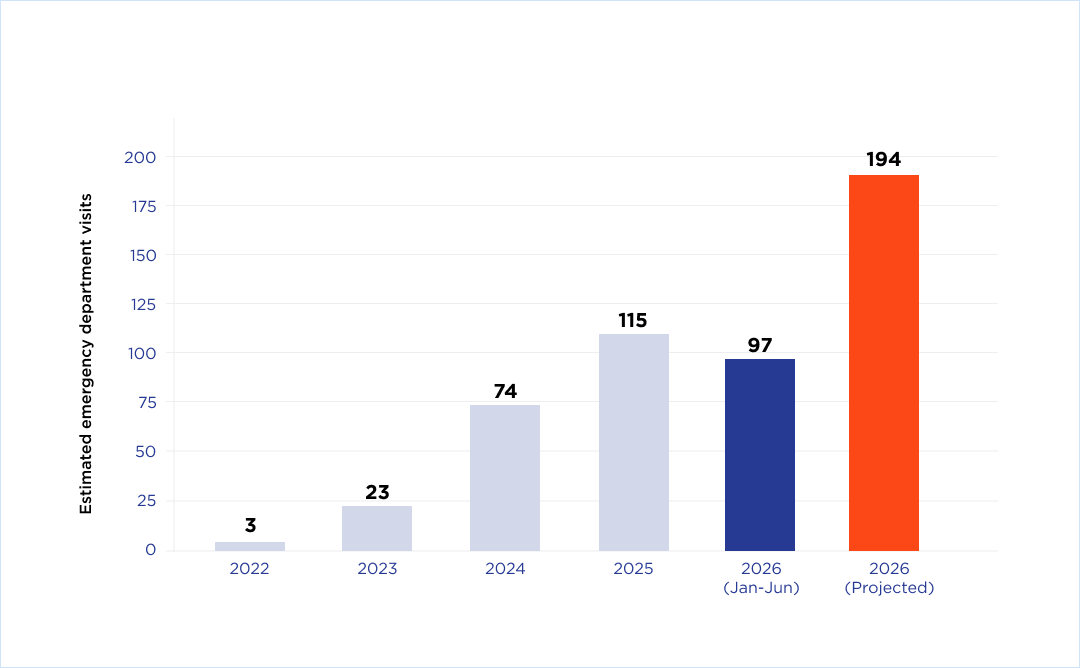
Source: Wolfson Children’s Hospital and Nemours Children’s Health, Jacksonville. The 2026 figure is the hospital’s own full-year projection based on 97 patients treated between January and June 2026.
Dr. John Draus, the trauma center’s medical director, has been warning families since 2025 about rising frequency and severity. E-bikes are popular holiday gifts, and he saw 19 new cases in January 2026 alone. The hospital’s July 2026 warning cited concussions, facial fractures, and traumatic brain injuries.
Memorial serves south Broward County and includes Joe DiMaggio Children’s Hospital. Its April 2026 data covers all ages and counts trauma alerts, the designation reserved for potentially life-threatening injuries.
Dr. Oliver Lao, medical director of pediatric trauma services at Joe DiMaggio, has emphasized that e-bikes are motorized vehicles capable of significant speed and that a crash can be life-altering. Doctors at Nicklaus Children’s Hospital in Miami-Dade report a significant increase in patients arriving with traumatic injuries.
| Measure | Finding |
| Change in trauma alerts, 2024 to 2025 | Up 178 percent, with the trend continuing into 2026 |
| Share of 2025 injuries involving patients under 18 | 44 percent |
| Age concentration among pediatric patients | More than half of 2025 pediatric injuries involved children ages 12 to 15 |
| Helmet use among injured riders | 82 percent were not wearing a helmet |
| Age range of patients treated | Young children through adults in their 80s |
| Injury types reported | Head trauma, skull fractures, lacerations, and orthopedic injuries, some with long-term complications |
Sources: Memorial Healthcare System, April 2026, and Axios Fort Lauderdale, July 2026.
| Location | Reported data | Period |
| Coral Springs | 49 e-bike, e-moto, and e-scooter crashes counted by police, with about two-thirds involving children | September 2025 to March 1, 2026 |
| St. Petersburg | Five fatal e-bike crashes, prompting targeted micromobility traffic enforcement | Roughly three months, reported March 2026 |
| Jacksonville | 106 children taken to the Wolfson trauma center, up from 97 at the end of June | January 1 to July 30, 2026 |
Gainesville, Ocala, and Lake City sit in a part of the state where local e-bike ordinances have been slower to appear than in South Florida and along the northeast coast. For families in Alachua, Marion, and Columbia counties, that means state law does most of the work, and state law is permissive. A 13-year-old in Gainesville can legally ride a Class 3 e-bike that assists up to 28 mph on the road with no license, no registration, and no insurance, and with no helmet once they turn 16.
We cannot tell you how many e-bike crashes happen in Alachua County, and neither can the state. Florida’s crash reports do not separate an electric bicycle from a conventional one, so there is no county-level count to publish.
What we can say is that Gainesville has roughly 56,000 students at the University of Florida alone, on a campus where bicycles and scooters are ordinary transportation. We found no comparable e-bike ordinance in Gainesville, Ocala, or Lake City as of September 2026. If your city or county has adopted its own rules, they are recent, so check with your municipal clerk before assuming state law is the whole picture.
Four factors show up repeatedly in the clinical literature, the CPSC investigations, and accounts from Florida law enforcement.
A Class 3 e-bike assists up to 28 mph, well beyond what a child can sustain on a conventional bicycle. Crash energy rises with the square of speed, which is why the Rady Children’s data shows more internal injuries and more admissions in speed-related crashes.
Under section 316.003(23), a Florida e-bike needs fully operable pedals, a seat, and a motor under 750 watts, and many devices sold as e-bikes fail that test. A December 2025 Mineta Transportation Institute study, summarized by Rady Children’s, counted electric two-wheelers parked at a dozen northern California middle and high schools and found nearly 90 percent may not meet that state’s legal standard, some with eight times the legal power.
Florida’s definition is the same 750-watt federal threshold, so the same devices are out of class here. As Volusia County Sheriff Mike Chitwood put it, a device doing 28 mph without a license or registration is an unlicensed motor vehicle. Once that is true, the insurance picture after a crash changes substantially, and so does who pays for your injuries.
Florida requires a helmet only for riders under 16. Eighty-two percent of injured riders at Memorial in 2025 had none, and nationally only 40 percent wore one. The bigger problem is that the helmets kids do wear were not built for these speeds. Children’s Hospital Colorado reports that a standard bicycle helmet is designed to protect a child’s head at 12 to 15 mph, while e-bikes travel at 20 mph or more, which is why their emergency doctors recommend a helmet with a chin guard for higher-speed e-bikes.
The Helmet Gap: E-bikes Outrun the Gear Kids Wear
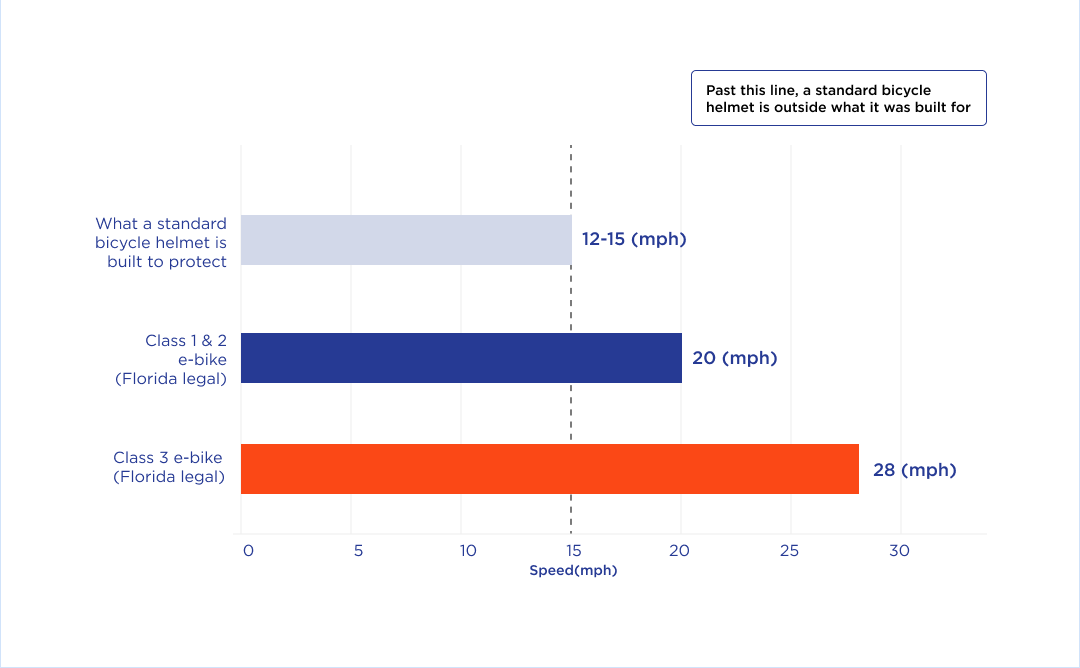
Sources: Children’s Hospital Colorado (May 2026) for the 12 to 15 mph protective range of a standard bicycle helmet, and Florida Statutes s. 316.003(23) for the Class 1, Class 2, and Class 3 assisted-speed limits. Out-of-class devices, which one December 2025 study found may account for nearly 90 percent of the electric two-wheelers parked at some schools, can exceed all three.
Florida crash reports do not reliably separate an electric bicycle from a conventional one, and hospitals are still standardizing how they record class and speed, so every figure here is conservative.
Florida’s framework lives in section 316.20655 of the Florida Statutes, with the class definitions in section 316.003 and the general bicycle rules, including the helmet requirement, in section 316.2065. An electric bicycle and its operator get all the rights and privileges of a bicycle and its operator, and carry all the same duties. Our attorneys have a fuller breakdown of Florida’s e-bike laws and where you can ride.
| Class | How the motor works | Assistance stops at | Where it can generally be ridden |
| Class 1 | Pedal assist only. The motor engages only while the rider is pedaling. | 20 mph | Anywhere bicycles are allowed, unless a local government has restricted it |
| Class 2 | Throttle assist. The motor can propel the bike without pedaling. | 20 mph | Anywhere bicycles are allowed, unless a local government has restricted it |
| Class 3 | Pedal assist only. The motor engages only while the rider is pedaling. | 28 mph | Anywhere bicycles are allowed, unless a local government has restricted it |
Source: Florida Statutes sections 316.003 and 316.20655. Florida allows Class 3 e-bikes on shared-use paths at the state level unless a local authority restricts them.
| Requirement | Status under Florida law | Statute |
| Driver license | Not required | s. 316.20655(2) |
| Vehicle registration | Not required | s. 316.20655(2) |
| Insurance or financial responsibility | Not required | s. 316.20655(2) |
| Statewide minimum riding age | None | s. 316.20655 |
| Helmet | Required for riders and passengers under 16 | s. 316.2065(3)(d) |
| Manufacturer class label | Required since January 1, 2021, showing class number, top assisted speed, and motor wattage | s. 316.20655(3) |
| Tampering with speed capability | Prohibited unless the class label is replaced after the modification | s. 316.20655(4) |
| Motor cutoff | Motor must disengage when the rider stops pedaling or applies the brakes | s. 316.20655(6) |
| Yielding to pedestrians on a sidewalk | Required, along with an audible signal before passing | s. 316.2065(9)-(10) |
| Local minimum age and photo ID rules | Local governments may adopt them | s. 316.20655(8) |
| Local limits on paths, sidewalks, beaches, and dunes | Local governments and path authorities may restrict or prohibit e-bikes | s. 316.20655(1) |
Source: 2025 Florida Statutes. Subsection (8), giving local governments authority over minimum age and ID requirements, was added by chapter 2025-149, Laws of Florida.
Subsection (8) matters most. Florida cities had argued for years that the state preempted them from restricting e-bikes by age, and the 2025 amendment resolved that in favor of local authority.
If you have read about Florida e-bike rules in the past year, you may have read about rules that do not exist. CS/SB 382 was covered widely as it moved through the Legislature, and several online guides still describe its provisions as current law.
| Date | Action |
| November 4, 2025 | Bill filed |
| February 25, 2026 | Passed the Florida Senate, 37 to 0 |
| March 9, 2026 | Passed the Florida House, 112 to 0 |
| March 17, 2026 | Ordered enrolled |
| June 15, 2026 | Presented to the Governor |
| June 25, 2026 | Vetoed by Governor Ron DeSantis |
| July 1, 2026 | Date the bill’s main provisions would have taken effect |
Sources: Florida Senate bill history for SB 382 (2026) and Florida Bicycle Association, June 2026.
No legislator in either chamber voted against it, and the bill had support from law enforcement agencies, local governments, and insurers. Governor DeSantis vetoed it on June 25, 2026, among his first vetoes of the 2026 session.
| Provision | What it would have done |
| Pedestrian speed buffer | Prohibited operating an electric bicycle faster than 10 mph when a pedestrian was within 50 feet, on sidewalks and pedestrian-designated areas |
| Yield and audible signal on shared paths | Required operators on shared pathways not adjacent to a roadway to yield to pedestrians and signal before overtaking |
| Uniform crash reporting | Required law enforcement agencies statewide to maintain consistent tracking records of e-bike and micromobility crashes |
| Micromobility Device Safety Task Force | Created a task force within the Department of Highway Safety and Motor Vehicles, including law enforcement, local government, industry, and medical representatives, to review state law and recommend changes |
| Penalty | A noncriminal traffic infraction for violations of the speed buffer |
Source: CS/SB 382 (2026) as passed by both chambers. None of these provisions is in effect.
The veto letter gave three reasons: a rider would struggle to measure a 50-foot buffer while riding, enforcement would need speed detection and surveillance the Governor warned would be turned on citizens, and the task force had no sunset date. Whatever the merits, the result is settled. Florida’s statutes are unchanged, nothing tracks e-bike crashes statewide, and the pressure has shifted to city halls.
Florida’s rules are now a patchwork, and enforcement varies even where an ordinance exists. Much of the activity traces to one crash. In February 2024, 66-year-old Megan Andrews died in Key Biscayne after a head-on collision with a 12-year-old on an electric bicycle; the village banned e-bikes and motorized scooters outright, and others followed.
| Community | Measure | Status |
| Key Biscayne | Banned motorized scooters and electric bicycles, converting a temporary ban into permanent law | In effect |
| Sunny Isles Beach | Banned e-bikes and scooters from sidewalks, set a minimum rider age of 16, and required riders to carry government-issued ID | In effect |
| Pinecrest | Lower speed limits on village paths and sidewalks, plus a mandatory safety class for anyone under 16 on a Class 2 e-bike | In effect |
| Miami-Dade County (Rickenbacker Causeway) | New rules for e-bikes and scooters on the causeway after a series of serious and fatal crashes | In effect |
| St. Petersburg, St. Pete Beach, and Madeira Beach | Minimum rider age of 16 for electric bicycles | In effect |
| Tampa | Restricts sidewalk riding in designated business districts | In effect |
| Deltona | Banned riders under 18 from e-bikes, e-scooters, and mopeds, and set a 15 mph speed limit | Age restriction suspended in August 2026; the 15 mph limit remains |
| Fernandina Beach | New rules for e-bike riders adopted unanimously | In effect |
| Jacksonville | Ordinance 2026-570 would add e-bike regulations to the city traffic code | Deferred in committee in August 2026 for rewrite |
| Nassau County schools | Students riding e-bikes must pass a safety course | In effect |
| Martin County | Sheriff’s office moved from an education phase to an enforcement phase on unsafe and illegal riding | Announced May 2026 |
Sources: CBS Miami, ClickOrlando, WFTV, News4JAX, and Central Florida Public Media. A snapshot as of September 2026, not a complete list. Confirm the current code with your city or county clerk.
Deltona shows what happens when an ordinance outpaces its enforcement. The city banned riders under 18 in July 2026, the sheriff declined to enforce it, and the commission voted 7 to 0 to suspend the age limit within days. Jacksonville’s ordinance was deferred in committee, and more Central Florida communities are drafting rules of their own.
The risks concentrate in a few specific behaviors, and most of them can be reduced without giving up the bike.
One conversation is worth having with your teenager. A device that reaches 28 mph is closer to a moped than to the bicycle they rode at nine, and a crash at that speed can cause injuries that do not show up right away.
An e-bike rider in Florida is not required to carry insurance, which leaves many families assuming there is no coverage after a crash. In most cases, the coverage exists somewhere else. What follows is general information, not legal advice.
Florida’s no-fault system, in section 627.736, provides personal injury protection benefits to people struck by a motor vehicle while not occupying a self-propelled vehicle. Bicyclists qualify, and because Florida treats an electric bicycle as a bicycle, e-bike riders generally do too. PIP typically provides up to $10,000, reachable through the rider’s own auto policy, a resident relative’s policy, or the at-fault driver’s policy.
One deadline matters more than any other: initial medical care within 14 days, or the PIP claim can be denied outright. Children will insist they are fine, so get them evaluated within days. PIP pays nothing for pain and suffering, so the real recovery comes from the at-fault driver’s bodily injury liability coverage and, where that driver was uninsured, from the family’s own uninsured motorist coverage.
An e-bike carries no liability insurance of its own. Where the rider is a minor, the family’s homeowners or renters policy may cover the claim, though many such policies exclude motorized vehicles, which matters when the device is not legally an electric bicycle. Defects are a separate route: of 145 e-bike incidents the CPSC investigated in depth, fire hazards accounted for 106. When a defect caused the crash, a product liability claim against the manufacturer, distributor, or retailer may be available alongside any other claim.
Potential Sources of Recovery After a Florida E-Bike Crash
| Scenario | Where compensation may come from |
| E-bike rider struck by a car | PIP benefits, the at-fault driver’s bodily injury liability coverage, uninsured or underinsured motorist coverage, and health insurance |
| Hit-and-run driver | Uninsured motorist coverage under the rider’s own policy or a resident relative’s policy, plus PIP |
| Pedestrian struck by an e-bike rider | The rider’s homeowners or renters liability coverage, the parents’ policy where the rider is a minor, and a direct claim against the rider |
| Crash caused by a defective bike or battery | Product liability claims against the manufacturer, distributor, or retailer |
| Crash caused by a road hazard or dangerous property condition | A premises liability claim, or a claim against a government entity subject to Florida’s sovereign immunity rules and pre-suit notice requirements |
| Rider on a rented or shared device | The rental operator’s coverage, subject to the terms of the rental agreement |
Comparative negligence. Florida uses modified comparative negligence under section 768.81. Your recovery drops by your share of fault, and above 50 percent you recover nothing. Insurers concentrate here, arguing about sidewalk riding, lights, helmet use, and whether the device was legal for the rider’s age. Those arguments turn on physical evidence, which is why it matters to preserve the bike, the helmet, and the scene photographs.
Time limits. For most negligence claims arising in Florida after March 24, 2023, the deadline to file suit is two years under section 95.11, and wrongful death claims get the same two years. Claims against a government entity carry pre-suit notice requirements, and claims involving minors have their own rules. Two years sounds generous and rarely is, particularly where a child’s prognosis takes months to become clear.
1. Get medical care immediately, and within 14 days at the absolute latest. Tell the provider it was an e-bike crash so it is documented that way.
2. Call law enforcement and make sure a crash report is created, even if the other driver wants to handle it privately.
3. Photograph everything: the bike, the helmet, the vehicle, the roadway, skid marks, signage, and the injuries.
4. Do not repair, discard, or return the bike or the helmet. If a defect is involved, the device is the evidence.
5. Get names and phone numbers for every witness before they leave.
6. Do not give a recorded statement to any insurance company before you have talked to a lawyer.
Meldon Law has represented injured people in Florida since Jeffrey Meldon opened the firm in 1971, and over five decades, we have recovered hundreds of millions of dollars for our clients from offices in the communities we live in. We are part of the same community you are.
These cases sit at an awkward intersection of motor vehicle insurance rules, bicycle statutes, local ordinances that changed last month, and product liability. Insurance companies know most families cannot see how those pieces fit together, and they price their offers accordingly. We fight for our clients on exactly that ground.
At the heart of the firm is a set of values we call Meldon CARES:
If you or your child was hurt in an e-bike, e-scooter, or bicycle crash anywhere in Florida, speak with our legal team today. There is no fee unless we win, and you face no risk in calling us.
The clearest summary of what has happened here is one Jacksonville trauma center: three children in 2022, 115 in 2025, and 97 in the first half of 2026. These devices arrived faster than the rules, the infrastructure, and the data systems. The safety bill lawmakers passed in 2026 did not survive the veto, so the responsibility now sits with families.
Until the law changes, the protections your child has are the ones you put in place: the right class of bike for their age, a helmet rated for the speed they will actually travel, and a conversation about what happens when a driver does not see them.
We will update this report as Florida’s law changes. If someone in your family has been hurt, contact Meldon Law for a free case evaluation. We fight for accident victims across Florida, and we have since 1971.
Three limitations are worth stating: the national figures are statistical estimates from a hospital sample, fatality reporting lags by up to two years, and Florida keeps no statewide count of e-bike crashes. All three point in the same direction, which is that these numbers understate the problem rather than overstate it.
This report is general information and public education, not legal advice, and it does not create an attorney-client relationship. Laws and local ordinances change, and any law’s application depends on the facts. If you have been injured, speak with a licensed Florida attorney. Prior results do not guarantee a similar outcome.
